



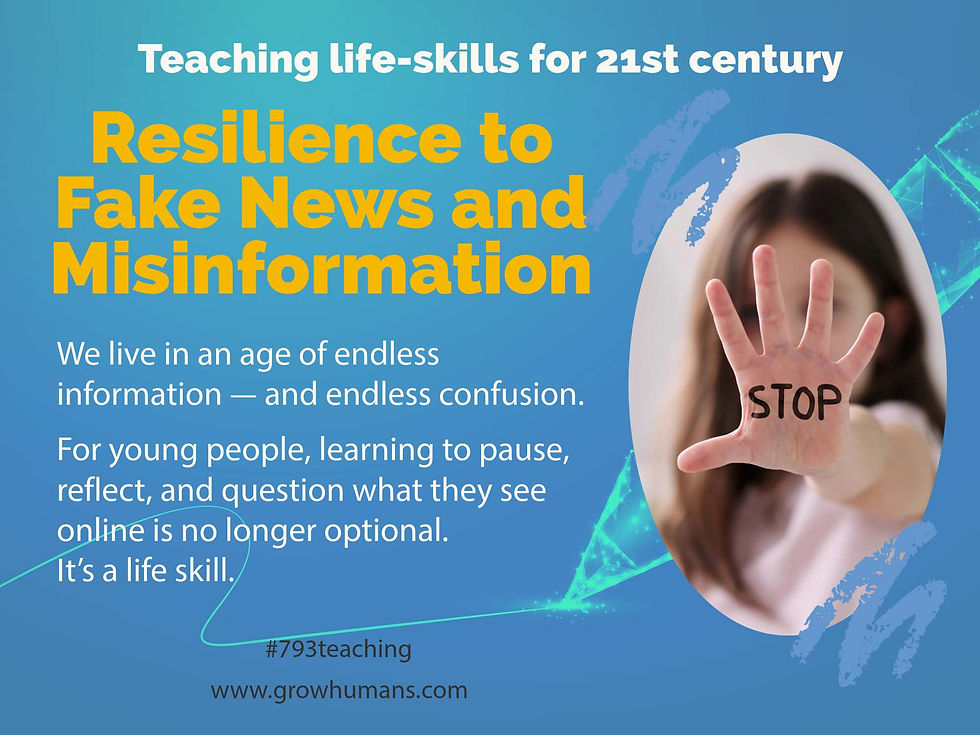
Resilience to Fake News and Conspiracy Theories

From social media to videos, games, and online discussions, young people are constantly exposed to messages that can confuse, frighten, or mislead them. In this world resilience to fake news and conspiracy theories is not just a skill — it’s a necessity.
“Calm minds can’t be manipulated.”
Young people today live in a world overflowing with information — and much of it isn’t true. Resilience to fake news and conspiracy theories means helping them think clearly, stay calm, and make sense of what they see and hear. It’s not about distrust — it’s about developing clarity, confidence, and care when evaluating information.
Why It Matters
Fake news and conspiracy theories can distort how children and youth see the world, create fear, and weaken trust. When we help them build resilience, we teach them to:
recognize false or misleading claims,
think before reacting emotionally,
look for reliable sources,
and discuss ideas calmly and respectfully.
These skills protect their mental health, strengthen relationships, and prepare them for responsible citizenship.
The Role of Education
Schools are safe spaces where young people can learn not what to think, but how to think.
Supporting resilience to misinformation in education means:
encouraging critical inquiry and open dialogue,
teaching media literacy and how algorithms influence what we see,
helping students understand emotion and persuasion in online content,
modeling respectful discussion of different opinions.
When young people feel safe to ask, “Is this true?”, they begin to build intellectual independence — and trust in their own reasoning.
Growing Resilience Through the Ages
Infancy (0–3 years): Learning trust and security.
Teacher’s role: Providing consistent warmth and presence — the foundation of truth and safety.
Preschool (4–6 years): Exploring truth and imagination.
Teacher’s role: Discussing what’s real and what’s pretend in stories and play.
Early School (7–10 years): Understanding facts and fairness.
Teacher’s role: Encouraging questions and explaining how evidence supports truth.
Tweens (11–13 years): Becoming aware of media and bias.
Teacher’s role: Teaching media literacy and helping students recognize emotional triggers.
Teens (14–18 years): Developing independent judgment.
Teacher’s role: Promoting research, discussion, and humility — the courage to say, “I might be wrong.”
Impact for Students, Teachers, and Families
When we help young people recognize truth and resist manipulation, we protect both their minds and their hearts. When schools and teachers foster classrooms of curiosity, safety, and thoughtful dialogue, children and youth can gain independence, calm, and confidence in what they believe. In a world full of noise, resilience to misinformation keeps them grounded in truth — and connected to one another.
© dr. Kristijan Musek Lešnik & Growhumans.
Like our posters? All text and visuals are original works.
Sharing is welcomed. Reposting or reproduction without credit is not permitted.
Please tag @GrowHumans when sharing.


Comments