



Supporting teachers/educators who shape minds, hearts, and futures!
Positive Attitude Towards Oneself
Helping Young People Build Confidence, Courage, and Self-Worth
How we relate to ourselves shapes everything we do.
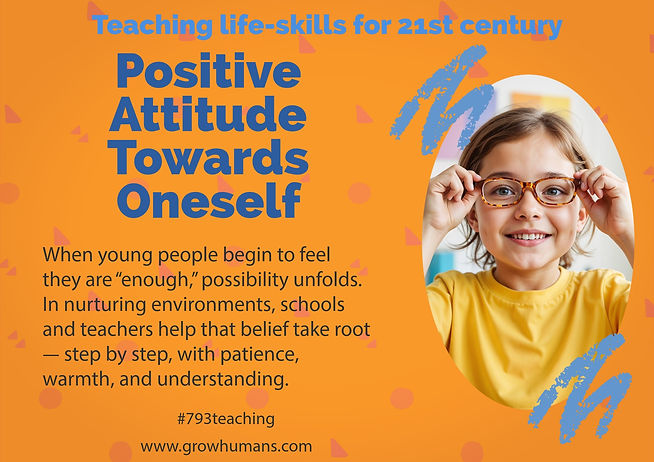
Every child comes into the world with potential — unique strengths, talents, and possibilities waiting to unfold. Whether that potential flourishes or fades often depends on one key factor: how they learn to see themselves.
A positive attitude toward oneself means holding a balanced, kind, and realistic view of who we are — our strengths as well as our limits. It’s not about perfection or inflated self-image, but about self-acceptance and self-belief grounded in real experiences, effort, and meaningful feedback.
When young people grow up with this sense of inner worth, they develop confidence, courage, and resilience — qualities that support them in learning, relationships, and all areas of life.
Why Positive Attitudes Toward Oneself Matter
How we relate to ourselves shapes everything we do. Young people who feel capable and valued approach challenges with curiosity and persistence. Those who constantly doubt their abilities may withdraw, give up easily, or rely too much on others’ approval.
Positive self-esteem gives young people the courage to try, fail, and try again — to see mistakes not as proof of weakness but as opportunities to learn.
At the same time, healthy self-esteem is not about entitlement or believing we’re better than others. It’s about recognizing our own worth while respecting the worth of others. It grows from authentic experiences of competence, encouragement, and belonging — and from the awareness that others are no less important or valuable than we are.
Research consistently shows that self-esteem and self-acceptance built during the formative years strongly predict well-being, mental health, and life satisfaction in adulthood. When young people learn early that they have value — even when they make mistakes — they carry that inner strength with them for life.
Supporting Positive Self-Attitudes in Education
Preschools, schools, and teachers play a vital role in how young people perceive themselves. Every interaction, every word of feedback, every learning experience contributes to how they answer the question: “Am I good enough?”
Supporting positive self-attitudes in education means:
Focusing on effort, progress, and learning — not just results.
Offering specific, encouraging feedback that helps students see what they did well and what they can improve.
Modelling self-compassion — showing that mistakes are normal and part of growth.
Helping them recognize their unique strengths and contributions.
When teachers nurture realistic self-confidence, they help young people become self-motivated learners who believe in their ability to grow.
Self-Development Through the Ages
Infancy (0–3 years): The Seeds of Trust and Security
In early childhood, a sense of self begins to form through secure relationships. When adults respond with care and consistency, children learn: I am safe. I matter.
Teacher’s role: Providing warmth, predictability, and loving attention. Responding to needs promptly helps build trust and self-worth.
Preschool Years (4–6 years): Discovering “I Can!”
Preschoolers begin to test independence and explore their abilities. Their self-esteem grows when they can do things “by myself” and receive positive recognition for effort.
Teacher’s role: Encouraging initiative and curiosity. Acknowledging persistence rather than just outcomes. Celebrating effort and courage.
Early School Years (7–10 years): Building Confidence Through Competence
School introduces new standards and comparisons. Children begin to evaluate themselves against peers, which can strengthen or weaken self-esteem.
Teacher’s role: Providing balanced feedback. Highlighting progress, not perfection. Encouraging cooperation over competition, and giving each child opportunities to succeed in different ways.
Tween Years (11–13 years): Navigating Self-Image and Belonging
Preteens become more self-conscious and sensitive to peer opinion. Their sense of self often fluctuates.
Teacher’s role: Fostering belonging and acceptance. Teaching that self-worth doesn’t depend on popularity or appearance. Discussing self-talk, inner dialogue, and the power of realistic thinking.
Teenage Years (14–18 years): Forming Identity and Purpose
Adolescents reflect deeply on who they are and what they stand for. They question values held by people around them and search for authenticity.
Teacher’s role: Offering respect and trust. Providing opportunities for choice, leadership, and contribution. Helping them connect self-worth to values, effort, and integrity — not external approval.
How Everyone Benefits
When young people learn to value themselves realistically and compassionately, they become more resilient, confident, and open to growth.
They develop stronger motivation, healthier relationships, and better emotional regulation. They’re less afraid of failure and more capable of perseverance.
Teachers benefit from more engaged, self-assured students who take ownership of their learning and behaviour. Classrooms become spaces of encouragement and mutual respect.
Ultimately, helping young people build a positive attitude toward themselves means teaching them to see their own worth — and to approach life with courage, gratitude, and hope. Because when they believe they are good enough, they begin to discover just how much they can become.



© Kristijan Musek Lešnik, 2025
© dr. Kristijan Musek Lešnik & Aparenttly.
Like our articles and posters? Sharing is welcomed — just tag @Aparenttly.
Reposting or reproduction without credit is not permitted.

