



Supporting teachers/educators who shape minds, hearts, and futures!
Grit and Perseverance
Helping Young People Keep Going When Things Get Hard
While talent may open doors, it’s grit and perseverance that carry us through them.
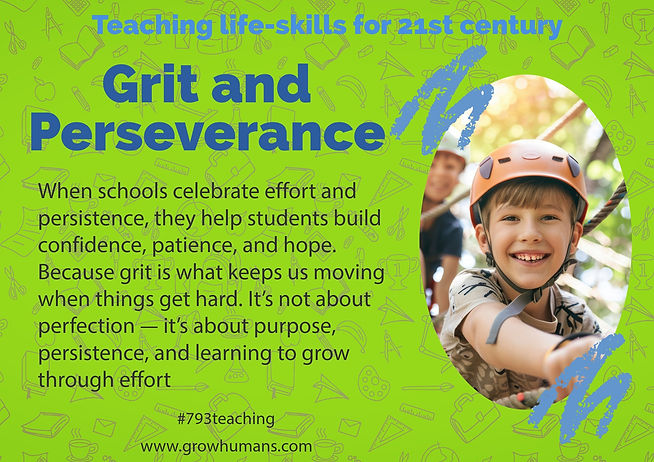
Every meaningful achievement — learning an instrument, mastering a sport, completing a project, or building a friendship — requires time, effort, and persistence. Yet today, in a world of instant gratification, young people often give up too quickly. They may expect success to come easily — and when it doesn’t, they lose motivation or interest. But the truth is simple: the deepest satisfaction comes not from what is easy, but from what we work hard for.
Grit and perseverance are the abilities to stay committed to long-term goals, even when progress feels slow or difficult. They help us focus, adapt, and persist — not through stubbornness, but through purpose and resilience.
Perseverance is not about “banging your head against a wall.” It’s about knowing why something matters and staying on course — while learning, adjusting, and growing along the way.
Why Grit and Perseverance Matter
Effort is the bridge between dreams and achievement. While talent may open doors, it’s grit and perseverance that carry us through them.
Young people who learn to persist through difficulty develop self-discipline, motivation, and confidence. They discover that progress takes patience — and that failure isn’t the end, but part of learning.
Developing grit and perseverance helps children and youth:
Set and pursue meaningful goals.
Overcome frustration and self-doubt.
Experience pride in effort and mastery.
Build resilience that lasts a lifetime.
Research by Dr. Angela Duckworth and others shows that grit — the combination of passion and sustained effort — is a stronger predictor of success than intelligence or talent. But beyond success, perseverance also brings emotional balance, self-efficacy, and a sense of purpose.
Why It Belongs in Education
Schools are the perfect place to teach perseverance. Every lesson, project, or creative task offers opportunities to practice patience, consistency, and effort.
Supporting grit and perseverance in education means:
Praising effort, improvement, and persistence — not just results.
Normalizing struggle as part of learning.
Setting realistic challenges that stretch but don’t overwhelm.
Encouraging reflection on progress and effort.
Modeling perseverance as educators — showing that determination and flexibility can coexist.
When young people learn that effort leads to growth, not frustration, they begin to take pride in persistence — and to enjoy the process of becoming better.
Developing Grit and Perseverance Through the Ages
Infancy (0–3 years): Learning Through Repetition and Effort
Even the youngest children show perseverance — trying to walk, speak, or reach for a toy again and again.
Teacher’s role: Encouraging effort, celebrating small victories, and creating a safe space for trying and failing.
Preschool Years (4–6 years): Trying Again After Failure
Preschoolers begin to face frustration when things don’t come easily. This is the moment to help them feel the joy of persistence.
Teacher’s role: Praising trying, not just succeeding. Sharing stories about persistence and emphasizing, “You did it because you kept trying.”
Early School Years (7–10 years): Developing Patience and Goal-Setting
Children begin to set goals and understand the value of working toward them. They can reflect on progress and improvement.
Teacher’s role: Guiding students in setting short- and long-term goals. Helping them see how small steps and consistent effort add up over time.
Tween Years (11–13 years): Learning from Setbacks
Preteens face growing academic and social challenges and often feel discouraged when things are hard.
Teacher’s role: Modeling persistence and sharing personal experiences of struggle and success. Encouraging reflection after setbacks — “What helped you keep going?”
Teenage Years (14–18 years): Building Purpose and Self-Discipline
Adolescents are defining who they are and what matters to them. Grit becomes connected to passion and purpose.
Teacher’s role: Helping students connect their goals to their values. Encouraging consistent effort in areas that bring meaning, and teaching balance — perseverance with self-care.
How Everyone Benefits
When perseverance becomes part of classroom culture, students learn that effort matters more than perfection.
Children and youth develop resilience, patience, and confidence — realizing that persistence leads to genuine accomplishment and fulfillment.
Educators experience more motivated, engaged students and a classroom atmosphere that values growth over instant success.
Perseverance teaches us all that the journey matters as much as the destination. When young people learn to keep going — with patience, purpose, and courage — they gain a skill that serves them for life.




© Kristijan Musek Lešnik, 2025
© dr. Kristijan Musek Lešnik & Aparenttly.
Like our articles and posters? Sharing is welcomed — just tag @Aparenttly.
Reposting or reproduction without credit is not permitted.

